
Guidance
DfE Statutory Guidance
Allergy Safety In schools (2026).
This statutory guidance recognises air quality as a core asthma control measure, stating that good ventilation, air quality monitoring and supplemental HEPA air filtration are essential.
DfE Guidance
Ventilation And Air Quality in Education and Childcare Settings (2026).
This guidance was updated in 2026. Refer to the Union's guidance below, and GO IAQS for health-based CO2 thresholds.

Short Video
A 10 minute video discussing the DfE Ventilation Guidance
The Air Quality Matters Podcast talks to leaders across the world and across sectors to discuss indoor air quality, ventilation and health. With over 20 years of experience, host and consultant Simon Jones discusses the guidance in less than 10 minutes and what it means.
Joint Union Guidance
Good Ventilation in Schools and Colleges and How To Achieve It
Practical steps.
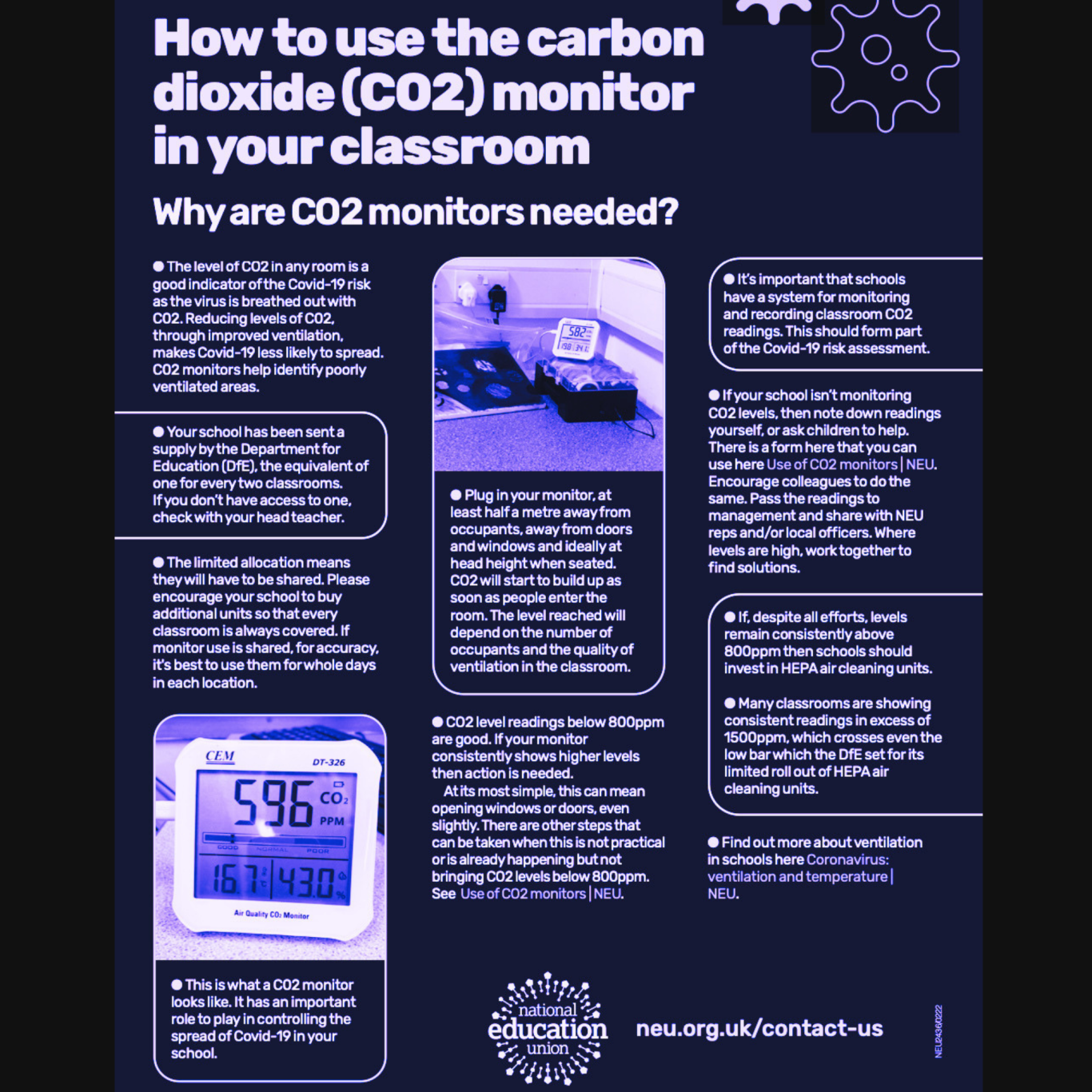
Union Guidance
How to use a CO2 monitor in a classroom
A comprehensive poster from the National Education Union. See also Health And Safety Executive and the Department for Education
Air Quality Standards
Global Open Indoor Air Quality Standards for Schools (GO IAQS for Schools)
Science-based indoor air quality standards. Developed by GO AQS, the proposed framework links clean air to children's health, well-being and learning.
Standards for New School Buildings vs Existing School Buildings
The Department for Education has recently introduced new design standards for new school buildings. These standards include requirements for ventilation and indoor air quality and reflect current engineering practice.
However, the DfE has also confirmed that it has no current plans to update Building Bulletin 101 (BB101), the non-statutory guidance covering ventilation, thermal comfort and indoor air quality in schools.
This means that while new schools are being designed to improved standards, the majority of pupils and staff remain in existing school buildings where ventilation guidance has not been updated.
A Gap in School Health Protection
The Department for Education has recently introduced statutory guidance on allergy safety in schools, recognising that healthy indoor air is an important part of protecting children with asthma and allergies. Its statutory allergy safety guidance identifies clean air as a core asthma control measure and highlights the importance of good ventilation, air quality monitoring and HEPA filtration where appropriate.
This represents an important step forward in recognising the link between indoor environments and children’s health. However, there remains a gap between recognising the importance of clean indoor air and ensuring it is consistently achieved across schools.
While DfE guidance recommends that schools monitor and manage ventilation and air quality, there is currently no consistent framework requiring schools to routinely assess classroom air quality, record performance or demonstrate that learning spaces are providing healthy indoor environments.
Schools already manage many health and safety risks through identifying hazards, implementing controls, monitoring effectiveness and reviewing arrangements. Indoor air quality should be approached in the same way.
Safe Air Schools believes that a proportionate, evidence-based approach to monitoring and managing indoor air quality would help schools support children with asthma and other health conditions, provide greater assurance to families and staff, and create healthier learning environments for everyone.
We Call For:
- Indoor air quality training for all school staff;
- Update to BB101 to reflect current scientific evidence and best practice;
- Introduction of continuous air quality monitoring in classrooms;
- Establishment of clear, health-based indoor air quality targets for all schools;
- Support for schools to improve ventilation through natural ventilation, mechanical ventilation where appropriate;
- Indoor air quality to receive the same level of attention as other important aspects of pupil health and safety.
Every child and every member of staff deserves to learn and work in a classroom with healthy indoor air.

Donate to Support Safe Air Schools
Community Interest Company No. 16405838. Registered Office: Southgate Chambers, 37 Southgate Street, Winchester, Hampshire. England, SO23 9EH
©2026 Safe Air Schools UK CIC