

Safe Air Schools and National Policy: Advancing Indoor Air Quality in Education

The National Allergy Strategy 2025 to 2035 and the Department for Education’s new Allergy Safety in Schools statutory guidance mark important developments in recognising the role that air quality plays in supporting school children’s respiratory health, asthma control and allergy safety.
For Safe Air Schools, these developments are particularly significant because our founder contributed to the work that informed both.
This blog explores what the National Allergy Strategy and the Department for Education’s Allergy Safety in Schools statutory guidance say about air quality, respiratory allergy and asthma, and highlights the contribution Safe Air Schools made to the process.

How Safe Air Schools became involved.
In 2024, our founder applied to participate in the National Allergy Strategy 10-Year Plan. Her background in respiratory care across hospital wards, on-call and intensive care, alongside six years of work on air quality in schools, made the connection between respiratory health, allergy and the environments in which children learn particularly relevant. She was accepted onto the Indoor and Outdoor Air Quality (Respiratory) Working Group and contributed over the next year.
During the introduction process, we were also pleased to see Catherine Sutton of Airborne Allergy Action on the working group. Catherine already works with Safe Air Schools, providing valuable experience and expertise.
What does the National Allergy Strategy say about air quality?
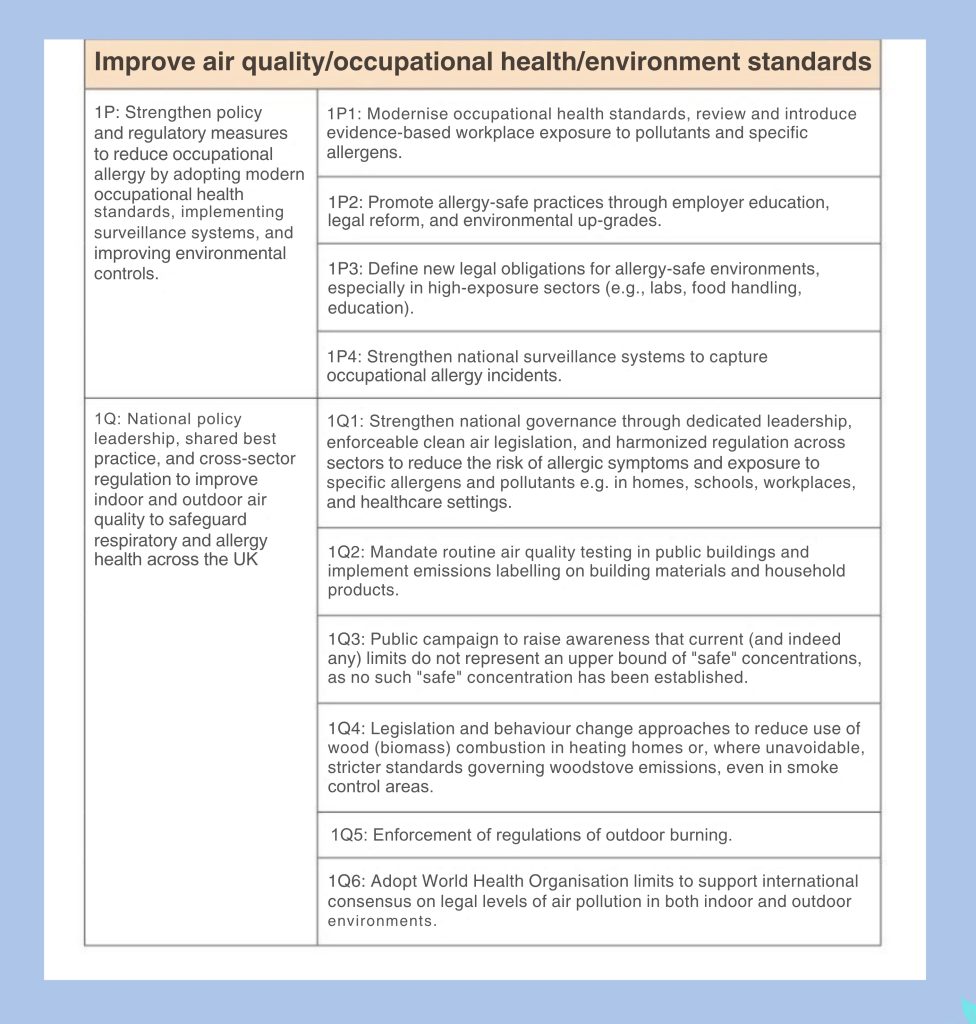
The National Allergy Strategy takes a broad approach to allergy, recognising that improving outcomes requires more than diagnosis, medication and emergency treatment. It also highlights the importance of air quality and environmental controls in preventing and managing allergy.
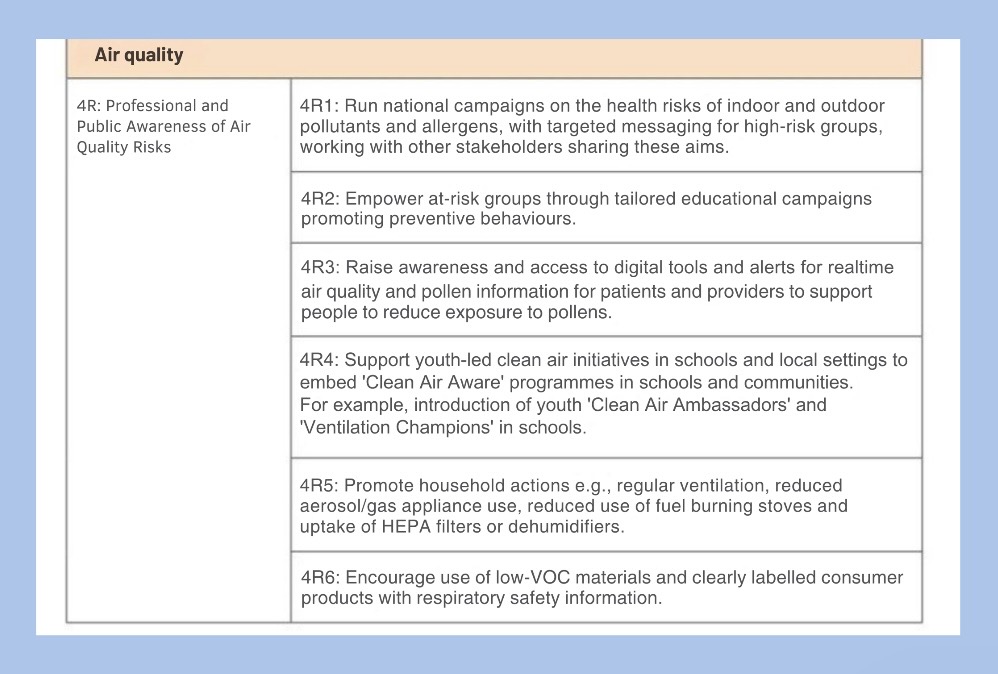
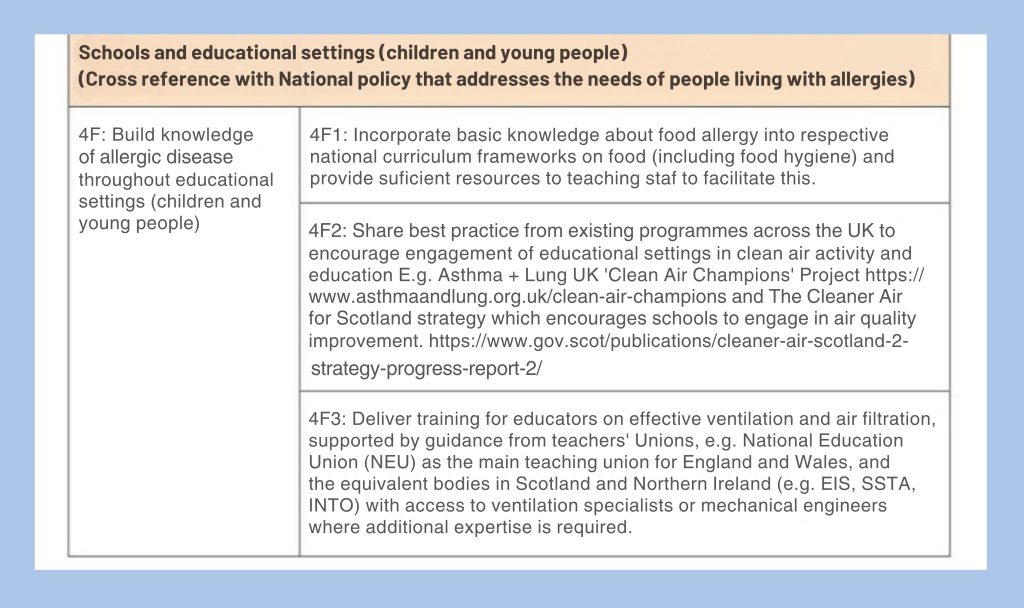
Specifically relevant to schools the Strategy calls for stronger standards, better monitoring including CO2 and indoor air quality monitoring, improved ventilation and air filtration, greater awareness of indoor and outdoor pollutants, and action to reduce exposure to allergens and pollutants. Together, these recommendations demonstrate how the Strategy connects cleaner air and healthier environments with allergy prevention and management across the UK. In doing so, the Strategy provides an important link between allergy, respiratory health and the environments in which children learn. It also reflects the approach advocated by Safe Air Schools: understanding the environment, improving ventilation and using filtration where appropriate.
Indoor and outdoor air are closely connected.
The working group’s focus on indoor and outdoor air is also particularly relevant to schools. Outdoor air quality can directly affect indoor environments: traffic pollution, particulate matter, smoke and pollen can affect the air children breathe in playgrounds while also entering classrooms through windows, doors and ventilation systems. At the same time, indoor contaminants such as viruses, mould and dust can affect the air children breathe inside the school. This reflects the whole-school approach advocated by Safe Air Schools recognising that indoor and outdoor environments are interconnected and both influence the air children breathe at school.


The new statutory framework.
The National Allergy Strategy provided the wider strategic context for improving allergy safety. Alongside this strategic work, campaigning by families and allergy organisations helped drive the move towards a statutory framework for allergy safety in schools.
Benedict’s Law is the name of the campaign driven by Benedict Blythe's family following the death of their five-year-old son from an allergic reaction at school The campaign called for stronger and more consistent allergy protection in schools. Safe Air Schools was pleased to support the campaign and help it reach 10,000 signatures in just 10 days. Thank you to everyone who saw our call and supported the petition through sharing and signing. The Children’s Wellbeing and Schools Act 2026 subsequently introduced new statutory duties relating to allergy safety in schools, including a requirement for applicable schools to have an allergy safety policy. The Department for Education's statutory guidance sets out what schools must do to meet these duties.
The progress made in allergy safety in schools reflects the sustained work of Benedict’s family, campaigners, clinicians, organisations and families who have continued to call for stronger protection for children with allergies. We would like to acknowledge the Benedict Blythe Foundation and everyone who has worked so hard to bring about this change in law and statutory guidance. Their work will immeasurably improve life for children and families living with allergy and undoubtedly save lives.
For information and resources, including the timeline to Law, we encourage families and schools to visit The Benedict Blythe Foundation, Natasha's Foundation. Allergy UK and Anaphylaxis UK.

Our contribution to the statutory guidance.
Following our work on The National Allergy Strategy, Safe Air Schools was invited by The Department for Education to contribute to the development of the statutory guidance.
As part of the consultation and development process, Safe Air Schools submitted evidence and recommendations relating to air quality, respiratory health and schools. Rather than reproduce our full submission, we are highlighting our contributions that subsequently appeared in the published guidance.
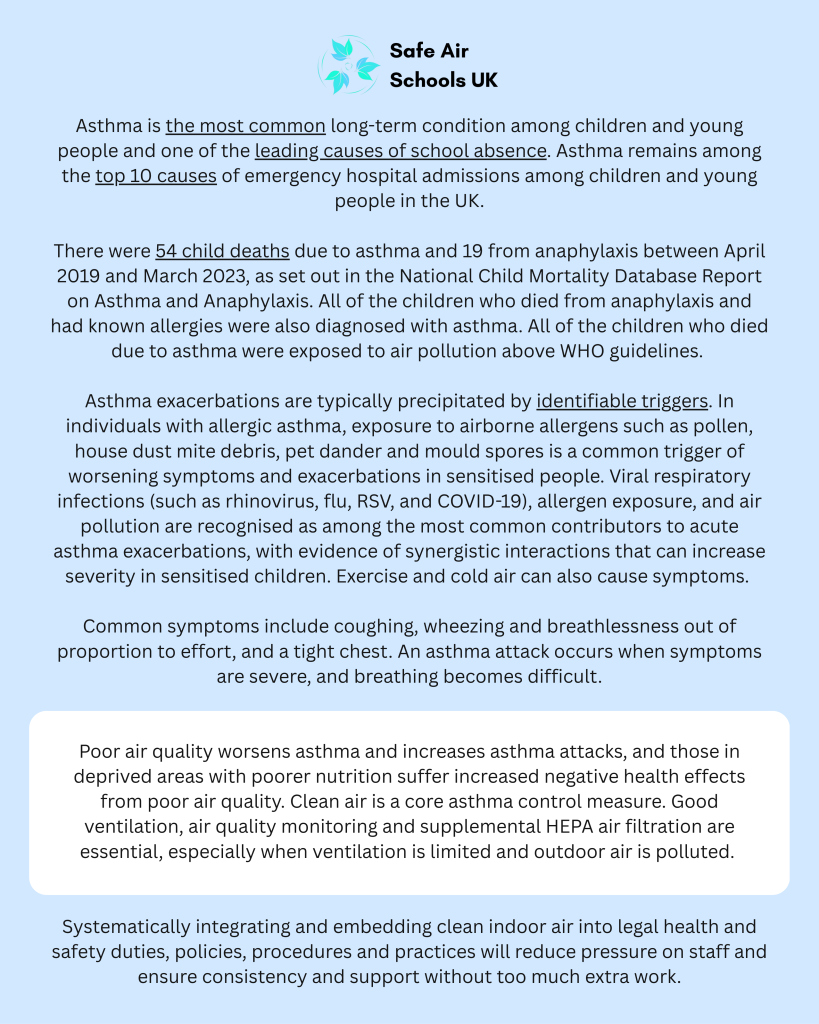
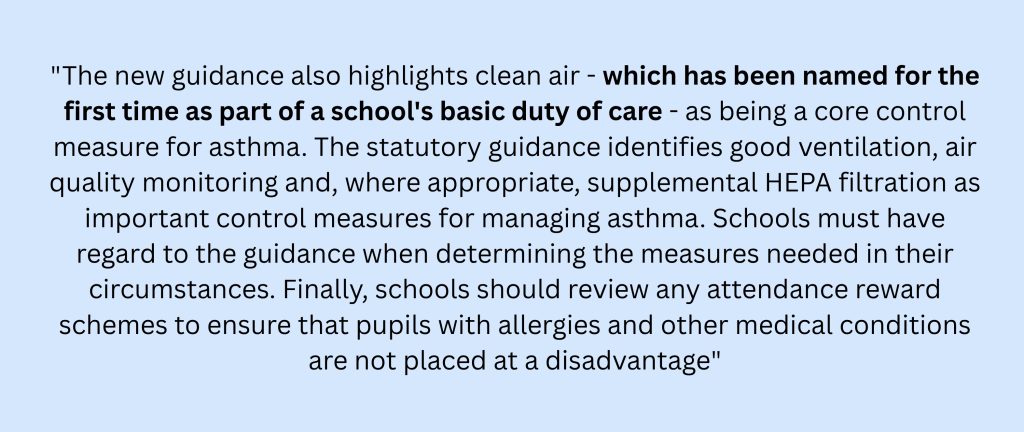
A key part of our submission was a request for a section dedicated to indoor air quality.The final guidance includes: “Clean air is a core asthma control measure.” For us, this is an important outcome of the consultation process.
Our contribution extended beyond environmental controls to how schools respond to pupils whose health conditions affect their attendance. Safe Air Schools raised concerns about 100% attendance awards. We highlighted that these awards disadvantage pupils with higher health risks, whose absences may be necessary and unavoidable, while also creating counterproductive pressure to attend school when unwell, particularly during periods of high illness circulation. Page 22 reflects some of this discussion where unacceptable practice is deemed as:
"excluding children and young people from rewards for 100% attendance where their non-attendance is the result of a medical condition or allergy".

From medical conditions and allergy to two pieces of guidance.
The development of the statutory guidance initially brought allergy and medical conditions together, before the work was separated into two strands: Allergy Safety in Schools, which has now been published, and the wider Supporting Pupils with Medical Conditions guidance, which is due later this year. Safe Air Schools were pleased to introduce Clinically Vulnerable Families to the Department for Education and their medical conditions work, bringing the experiences and perspectives of clinically vulnerable children and families into the development process.
We hope that our full submission on air quality will be considered as part of the update to the Supporting Pupils with Medical Conditions guidance. We will publish our submission in due course.

What does the statutory guidance mean for schools?
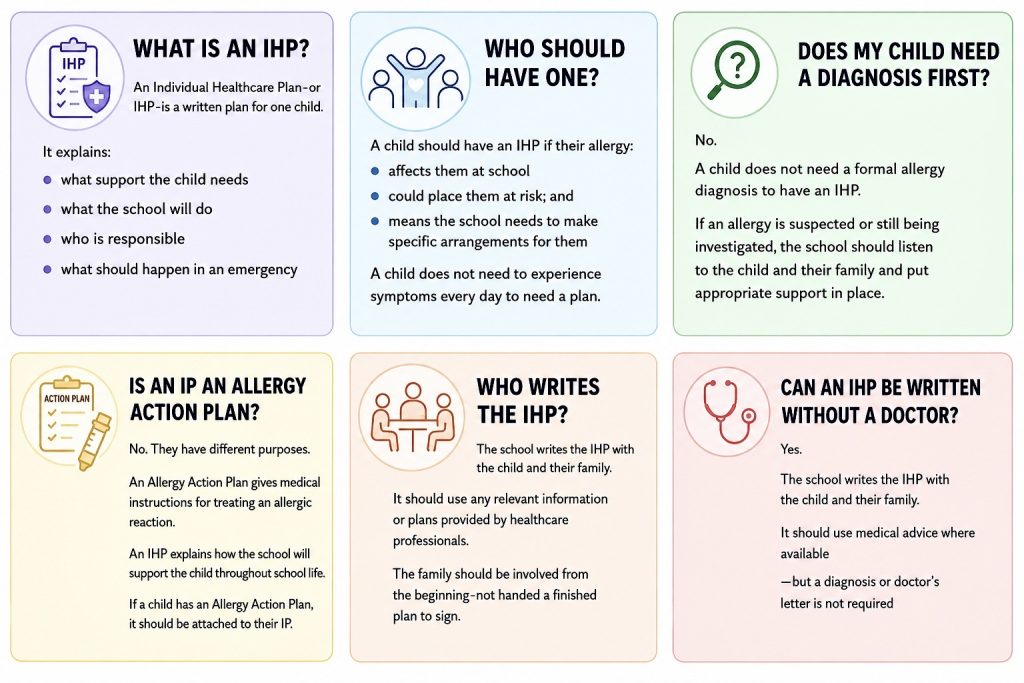
We wanted the guidance to recognise that allergy safety encompasses both individual support and the environment in which children learn. Individual Healthcare Plans (IHPs) are an important part of supporting children with allergies and respiratory conditions, including identifying individual triggers and setting out appropriate measures to manage them. Where an identified trigger is environmental, schools should consider the wider school environment and measures that may help reduce exposure to that trigger.
The National Education Union has produced some FAQ's to assist schools, stating:
The Benedict Blythe Foundation has produced a useful summary regarding Individual Healthcare Plans that we have reproduced here:
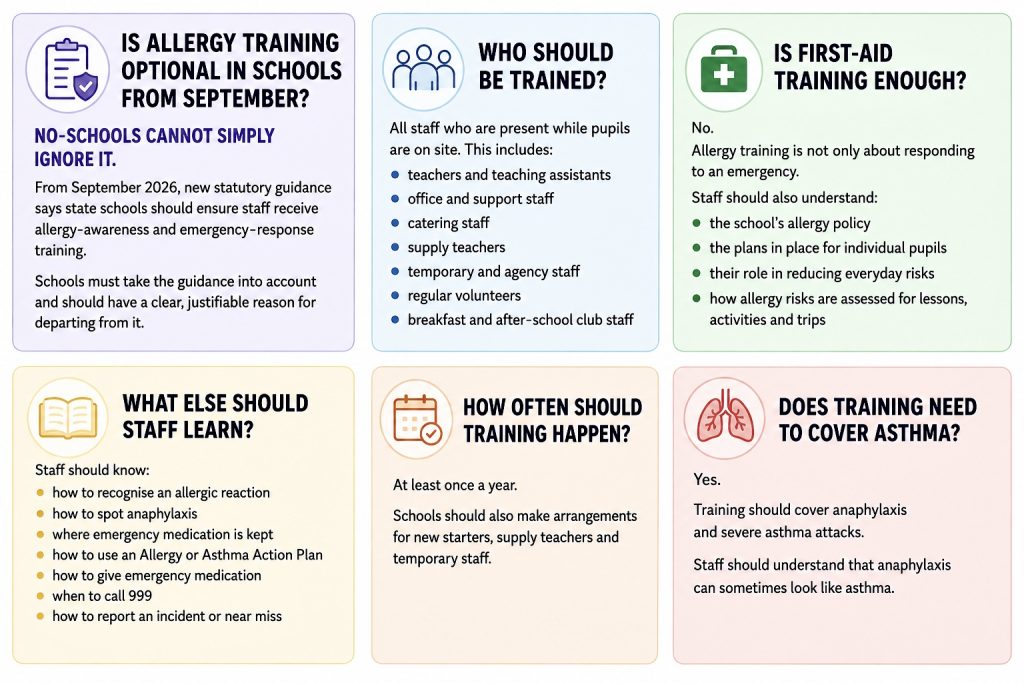
They have also produced a useful series of summaries on training, seen here:
From policy to implementation.
The National Allergy Strategy includes indoor air quality monitoring, adequate air exchange and HEPA filtration within its respiratory health objectives, while the statutory allergy guidance goes further by explicitly recognising clean air as a core asthma control measure and addressing ventilation, air quality monitoring and supplemental HEPA filtration within its advice to schools.
For Safe Air Schools, this represents important progress.
Our founder’s involvement began with the National Allergy Strategy and its Indoor and Outdoor Air Respiratory Working Group. It has continued through our contribution to the development of the statutory allergy guidance.
The policy discussion about air quality in schools has moved forward. The next step is making it work in practice.
The statutory guidance comes into effect from September 2026, giving schools a clear framework for strengthening allergy safety.
For schools, this provides an opportunity to ask: Do we understand the air quality in our school environment? Do we have the monitoring, information and training we need? And do we have the resources to act where improvements are needed?
Parents can ask: How does the school consider air quality when supporting children with asthma and allergies? Does the school have the monitoring and expertise it needs to identify problems? And, where an issue is identified, does it have the resources and practical support to act?
Safe Air Schools is grateful for the opportunity to contribute to the All-Party Parliamentary Group on Allergy. Our work now focuses on helping schools put policy into practice, while advocating for healthier, safer and more inclusive learning environments in our founding county of Hampshire and across the UK.