Open Letter to the Four Nations: What Happened Next?
An open letter calling for urgent action to improve indoor air quality in schools was sent to education ministers and children’s commissioners across all four UK nations. It highlighted the importance of healthy indoor air in protecting children’s health, supporting learning and creating safer, more inclusive schools.
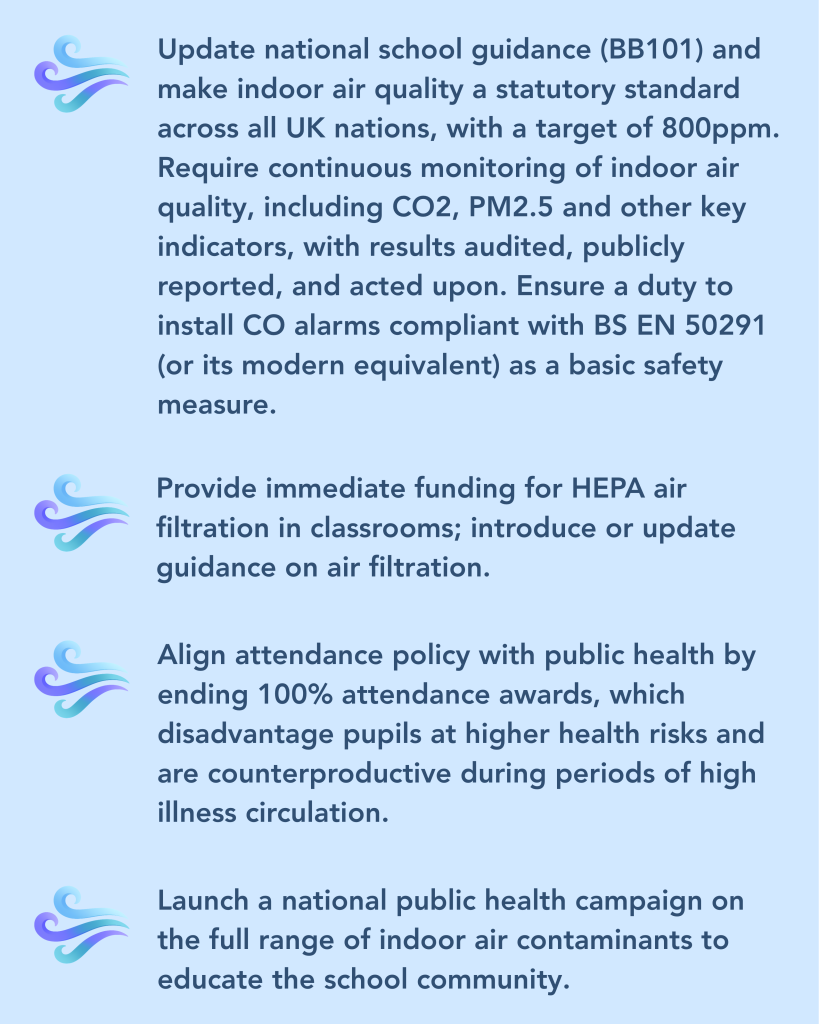
Our letter set out four clear calls for government action, translating existing evidence and recognition of the problem into practical measures to improve classroom air quality across the UK.
What were we calling for?
Who supported the letter?
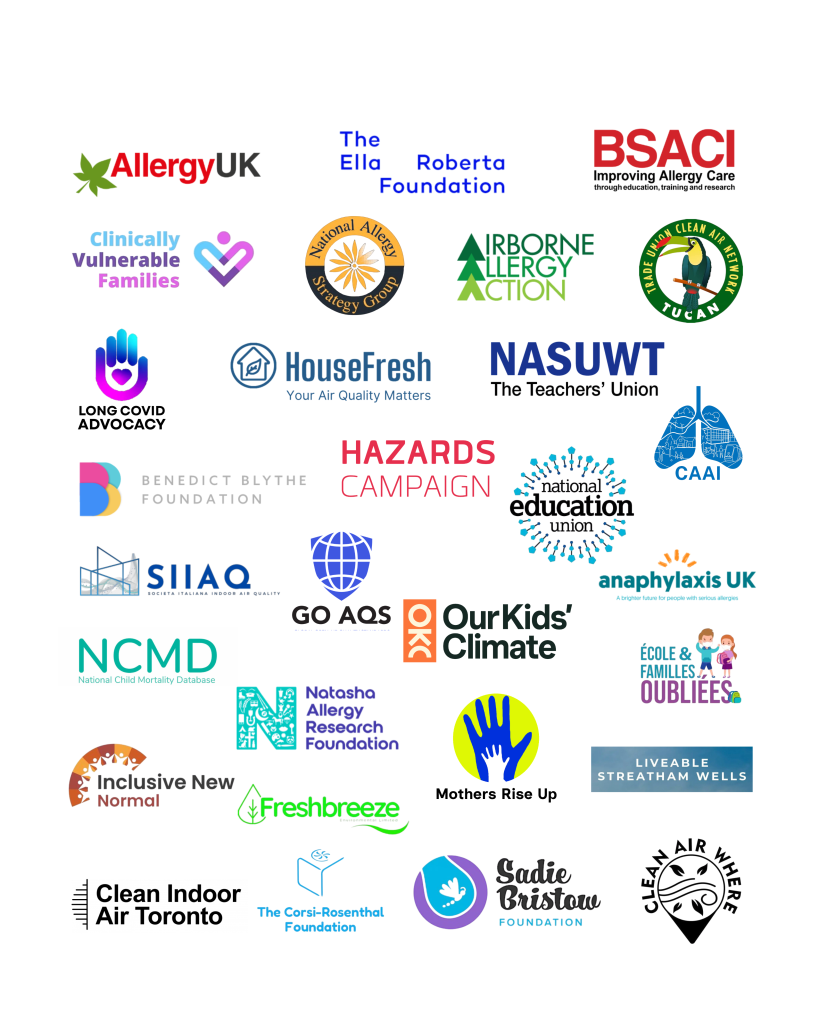
The letter brought together a broad coalition of expertise spanning health, education, air quality, allergy, workplace safety and children’s rights. Signatories included MPs and other public figures, medical and public health professionals, paediatric and respiratory specialists, scientists, researchers, academics, teachers, trade unions, charities, campaigners, parents and community organisations. The breadth of support reflects the shared concern across professional fields and communities about classroom air quality and its impact on children and education staff.
What responses did we receive?
We received responses from the Department for Education in England, the Welsh Government and the Northern Ireland Commissioner for Children and Young People (NICCY). We have not yet received a response from the Scottish Government or Northern Ireland’s Education Minister. Although NICCY’s response provides an important children’s rights perspective, it does not represent a government commitment to implement the policy measures requested in our letter.
The responses differed in their focus and in the extent to which they addressed our four calls.
England
The Department for Education acknowledged the importance of ventilation and indoor air quality in schools, stating that these issues are addressed through its school condition programmes. It also highlighted its provision of CO₂ monitors to all state-funded education and care settings, alongside guidance on monitoring ventilation and the use of air-cleaning units. In addition, it referred to capital funding to support improvements to school buildings.
The response also addressed outdoor air quality, noting that it is the responsibility of local authorities who must assess air quality and take action where relevant legal objectives are not met. Where an Air Quality Management Area is declared, an Air Quality Action Plan is required. Local authorities that do not have these are required to develop a local Air Quality Strategy.
The Department also referred to SAMHE (Schools’ Air quality Monitoring for Health and Education), a government-funded research project involving the Department for Education and the Engineering and Physical Sciences Research Council (EPSRC). It stated that it has seen the value of the data collected and analysed through the project.
It also highlighted that officials are aware of air-filtration work being carried out by Hertfordshire County Council and the Greater London Authority and will continue engaging with both programmes to review their findings.
Ventilation standards and incentives
BB101 is non-statutory guidance published by England’s Department for Education on ventilation, thermal comfort and indoor air quality in schools. It is also referenced in school design or building regulations guidance across Wales and Northern Ireland, while Scotland’s 2026 proposals for updating school premises regulations recommend including a reference to it. The status and application of BB101 therefore vary across the four nations.
The Department did not commit to updating BB101. This is particularly relevant in light of findings from SAMHE, which analysed 38,000 schooldays of air-quality data from 346 schools across the UK.
SAMHE’s 2024 policy recommendations identified the need to update BB101 to strengthen its focus on classroom ventilation and indoor air quality, including the recommendation to maintain CO₂ concentrations below 800 ppm. Further, it recommended regular monitoring of CO₂ and PM2.5 in all occupied spaces in UK schools, alongside changes to legislation to prevent classroom overcrowding.
This leaves an important question about how evidence from government-funded research and ongoing local programmes will translate into future guidance, policy and practice.
Attendance rewards and incentives
The Department stated that attendance rewards and incentives are local initiatives led by individual schools. Where schools choose to use them, it said they should do so without discrimination. The department also stated:
"we would expect schools to consider reward systems that are inclusive and appropriate for all pupils, including those with disabilities or long-term health conditions".
Wales
The Welsh Government’s response placed particular emphasis on the relationship between air quality, health and school attendance.
It highlighted the Clean Air Plan for Wales and the role of ongoing research in understanding indoor air pollution. It referred to the 2022 Air Quality Expert Group report, which identified areas where further evidence is needed to improve understanding of the health risks associated with indoor air pollution and how these risks can be mitigated. The response also recognised the importance of appropriate ventilation in schools in managing indoor air quality.
The Welsh Government said it would continue to work with academia, public health organisations and other partners as new evidence emerges.
Welsh Government guidance, published in 2021, advises schools to use CO₂ monitors to assess classroom ventilation, aiming for readings below 800 ppm and investigating persistently high readings. In terms of support and escalation routes, Wales directs schools to local authority estates and corporate health and safety teams for support for maintained schools. It guidance is however, narrower in scope than England’s 2026 guidance, which covers wider indoor air quality monitoring and the use and maintenance of HEPA air-cleaning units.
Since our letter was sent, the Welsh Government has published its Promoting Awareness of Air Pollution in Wales: Delivery Plan 2025 to 2028. Published in March 2026, the plan sets out actions across four themes, including a dedicated Children and Young People theme. These include raising awareness of air quality among school children and staff, developing air-quality teaching resources and working with local authorities and schools to increase the profile of national air-quality campaigns.
The plan also contains a specific commitment to school monitoring:
“We will provide opportunities for Local Authorities to bid for monitoring equipment for schools to increase the visibility of air quality and maximise learning opportunities.”
It also proposes exploring school-based community sensor networks.
This builds on earlier work in Wales. In 2021, the Welsh Government provided funding for more than 30,000 CO₂ monitors for schools, colleges and universities. Research into their use found that most respondents considered the monitors useful, particularly for raising awareness of ventilation issues, although it also identified a need for further support where schools found ventilation problems that they could not resolve themselves.
This history makes the new commitment particularly interesting. Wales is continuing to build on its experience of using monitoring in education settings, while broadening its focus towards wider air-quality awareness, education and community engagement.
The Welsh response was particularly clear on attendance and health. It stated that:
“illness is a legitimate reason for absence”
and that schools should not encourage attendance where this could compromise pupil or staff health. It also referred to guidance advising schools to promote good ventilation and follow public-health advice to minimise illness-related absence.
This somewhat reflects the principle behind our call to align attendance policy with public health. The response focused on wider attendance guidance rather than making a specific commitment to end 100% attendance awards.
What this means for our four calls
Overall, the Welsh response and subsequent Delivery Plan show continued progress in air-quality awareness, education and monitoring. It will be interesting to see how these initiatives translate into practical improvements in classrooms, including whether schools receive the monitoring support they need. The response did not make specific commitments on continuous monitoring requirements or national funding for HEPA filtration.
Northern Ireland
The response from the Northern Ireland Commissioner for Children and Young People (NICCY) placed particular emphasis on children’s rights and the experiences and views of children and young people.
The Commissioner reaffirmed support for children’s right to health under Article 24 of the United Nations Convention on the Rights of the Child. The response also highlighted the UN Committee’s concerns about the impact of air pollution on children’s health and the recognition of clean air as an important part of children’s right to a healthy environment.
Importantly, NICCY brought forward the experiences and voices of children and young people themselves. The Commissioner noted that NICCY was a core participant in Module 8 of the UK COVID-19 Inquiry, which focused on children and young people, and that members of its youth panel shared their experiences with NICCY’s legal team. Their experiences, including the need for air filtration in classroom settings, were reflected in statements to the Inquiry. The response also highlighted the work of youth panel member Seren, who has advocated passionately for better ventilation in schools. This provides a direct example of a young person bringing the issue of classroom air quality into the wider conversation about children’s health and wellbeing.
The response highlighted that NICCY also hosted its youth-led Hear Our Voices event in March 2025, where good, safe and clean air emerged as a clear call from young people in relation to climate and environmental breakdown.
The Commissioner described further work through NICCY’s intervention in the Clean Air NI legal case, brought by Friends of the Earth Northern Ireland against the Department for Infrastructure. NICCY intervened to highlight the detrimental impact of poor air quality on children’s health. The case concerns long-standing issues around vehicle emissions testing and the identification of vehicles producing dangerous levels of particulate pollution.
What this means for our four calls
NICCY’s response makes an important contribution to the wider case for action. By highlighting children’s rights, the experiences shared through the COVID-19 Inquiry and young people’s calls for cleaner air, it reinforces the importance of ensuring that the environments in which children learn support their health and wellbeing.
Although NICCY is not the government department responsible for implementing the policy measures in our letter, its contribution brings children’s voices into the discussion and strengthens the case for practical action. The next step is to build on this recognition by engaging with the relevant decision-makers on indoor-air-quality standards, monitoring, appropriate filtration and attendance policies that protect children’s health.
In terms of existing provision and outstanding priorities we do know that Northern Ireland provided CO₂ monitors to schools and issued ventilation guidance through the Education Authority in December 2021. In January 2022, The Education Minister confirmed that air filtration units had been purchased for use where deemed needed. In February 2026, the Education Minister confirmed that this guidance remains relevant, but that providing and installing portable air purifiers across all schools is not currently being considered. In terms of escalation and support for schools, the Education Minister also confirmed in February that school experiencing ventilation problems should contact the Education Authority to determine whether further action is necessary.
It has not been possible to verify an 800 ppm CO₂ target in Northern Ireland’s guidance, nor a requirement for continuous monitoring of CO₂ or air quality.
Northern Ireland’s public health advice recommends that children who are unwell with a high temperature stay at home until their temperature has returned to normal and they feel well enough to return to school.
Northern Ireland also has a draft Clean Air Strategy to 2032, which includes public awareness among its objectives, but no specific national campaign on indoor air quality in schools has been identified.
Scotland
The Scottish Government did not respond to our letter, so its position on our specific requests remains unclear.
However, we do know that the Scottish Government provided £10 million in 2021 and a further £4.8 million in 2022 for school ventilation and CO₂ monitoring. It reported that more than 51,000 learning, teaching and play spaces had been equipped with CO₂ monitors.
Further, its March 2026 consultation on school premises regulations addresses ventilation and proposes referencing BB101, but does not propose a specific 800 ppm CO₂ target or an explicit requirement for continuous monitoring.
On HEPA filtration, the Scottish Government has previously indicated that decisions rested with local authorities, taking account of individual circumstances. Earlier funding was available to support urgent ventilation improvements, potentially including filtration where appropriate.
In terms of escalation and support for schools, Scotland’s March 2022 guidance provided for local reporting of persistent CO₂ concerns and remedial action. However, this guidance related to the 2021/22 school year.
Scotland updated its national school attendance guidance in March 2026, and recognises illness as a legitimate reason for absence.
Moving forwards
Since our open letter was sent, there have been important developments in guidance, research and national policy. These provide opportunities to build on the evidence and awareness highlighted by our campaign.
However, publication of guidance is only one part of the picture. We also need to understand how it supports schools in practice, what resources are available, and how children and staff can be protected when problems are identified.
The following sections consider progress against each of our four calls.
Updating school ventilation standards
- What has changed?
Shortly after our letter was sent, the Department for Education published updated guidance on ventilation and air quality in education and childcare settings in England.
The guidance recommends regular monitoring of ventilation and air quality, explains how CO₂ monitoring can help identify poorly ventilated spaces, and provides practical advice on improving ventilation. It also includes updated guidance on the use of air-cleaning units.
Simon Jones, founder of The Air Quality Matters Podcast, discusses the guidance here in less than 10 minutes and what it means.
The Department for Education also pointed us to its new Employer’s Requirements, published in February 2026, which set out requirements for the design and construction of school and college buildings.
Independent research has also continued to strengthen the evidence base around school air quality.
- What remains?
These developments are important, but they are not the same as updating BB101. In a subsequent response, Josh MacAlister, Parliamentary Under-Secretary of State for Education, confirmed:
“At present, we have no proposals to update the non-statutory BB101 publication.”
This leaves an important question about how emerging evidence, including the findings from the government-funded SAMHE project, will inform future guidance. New and existing school buildings also present different challenges. The question is not only what standards apply when a new school is designed, but how existing classrooms can be assessed, monitored and supported.
Supporting schools with air cleaning
- What has changed?
The February 2026 DfE guidance provides specific advice on air cleaning units.
It recognises circumstances where air cleaning may be useful because of particular air quality concerns. It states that where an adequate supply of fresh air cannot be maintained, schools might consider using air cleaning units until remedial work can be carried out. The guidance recommends HEPA filtration and provides a minimum specification for portable air cleaning units used in education and childcare settings. It also makes an important distinction: air cleaning units can reduce airborne contaminants, but they do not improve ventilation or lower CO₂ levels.
There has been a significant development in England. The Department for Education published new statutory allergy safety in schools guidance in July 2026, with the new statutory requirements applying from September 2026. This explicitly recognises clean air as a core asthma control measure, highlighting ventilation, air-quality monitoring and supplementary HEPA filtration. This strengthens the recognition of healthy indoor air in national guidance and is an important step forwards.
- What remains?
The next challenge is ensuring that schools have the information, equipment, expertise and resources to respond effectively to the conditions in their buildings.
The DfE says it provided CO₂ monitors to all state-funded education and care settings between 2021 and 2023. However, evidence from December 2021 showed that provision did not meet every participating school's monitoring needs. In the Office for National Statistics' School Infection Survey, 51% of participating headteachers reported that they had not been supplied with enough monitors to provide the coverage they needed. This is historical evidence, rather than a measure of current provision, but it illustrates why distributing equipment is only one part of an effective monitoring programme.
The Department’s current guidance also states that it will not replace faulty or damaged monitors supplied through the ventilation programme. We have not identified published national data showing how many of the monitors originally provided remain available and operational
For schools to take effective action, they need support to identify potential problems, monitor and interpret air quality data, and access expert advice when issues cannot be resolved through simple measures. England does not appear to have a dedicated national escalation route for schools experiencing persistent indoor air quality problems. Department for Education guidance does, however, advise schools concerned about outdoor air pollution to seek advice from a ventilation specialist. With more than 25,000 British schools in areas exceeding World Health Organisation (WHO) air quality guidelines a key question remains: are schools aware of the risks, the guidance available and the support they can access to address them? Capital funding may be available for eligible building improvements, subject to the relevant funding criteria and, where required, a successful business case. The Department is clear that use of portable air filters must not delay more permanent fixes.
Ending 100% attendance awards
- What has changed?
The new statutory allergy safety guidance states that children should not be excluded from 100% attendance rewards where their absence results from a medical condition or allergy.
- What remains?
We are now watching closely to see how this principle develops across a broader range of medical conditions. The Department for Education is updating its statutory guidance on supporting pupils with medical conditions. Following a consultation to which Safe Air Schools contributed a dedicated section, the Department confirmed that it will revise the draft guidance and continue working with the Department of Health and Social Care before publication.
Raising public awareness
- What has changed?
There is growing recognition of the importance of air quality within national policy, research and public engagement.
The National Allergy Strategy 10-Year Plan includes consideration of indoor and outdoor air quality and public awareness. Safe Air Schools contributed to the strategy’s Indoor and Outdoor Air Working Group, and we will continue to follow how its recommendations translate into policy and practical support.
In Wales, the Promoting Awareness of Air Pollution in Wales: Delivery Plan 2025 to 2028, published in March 2026, sets out actions to raise awareness among school children and staff, develop air-quality teaching resources, and work with local authorities and schools to increase the profile of national air-quality campaigns. It also provides opportunities for local authorities to bid for monitoring equipment for schools.
In Northern Ireland, NICCY has highlighted children’s rights and young people’s own experiences of air quality, including concerns raised through the UK COVID-19 Inquiry. This provides an important reminder that children’s voices should be part of decisions about the environments in which they learn.
These developments show that awareness of healthy air in educational settings is continuing to develop across the UK, although approaches differ between the four nations.
- What remains?
We have not identified a dedicated UK-wide public health campaign focused specifically on healthy indoor air in schools.
Raising awareness remains important because families, teachers and school leaders need accessible information about what healthy classroom air means, how to recognise potential problems and what they can do when concerns arise.
From policy to implementation
Across all four calls, a common question remains: how do policy and guidance translate into everyday practice?
Schools must be supported to identify air-quality concerns, who is responsible for addressing them, whether suitable monitoring equipment is available and working, and how to interpret the results. Where a problem is identified, they also need clear advice and access to appropriate support, particularly when it cannot be resolved through simple changes.
These questions are especially important in existing school buildings, where the right approach will depend on the building, its ventilation systems and the circumstances.
This is why our next priority is our 2026 Campaign: Support for Schools. We want to build on our findings and help keep focus on the practical steps, resources and support needed to turn growing recognition of healthy indoor air into meaningful improvements for all children and the staff who work with them.
Thank you to everyone who signed or shared our open letter. Your support has helped unite voices across public health, medicine, scientific research, education, sustainability and clean air advocacy, strengthening the call for meaningful action on classroom air quality.
At the heart of this work is a simple but profound responsibility: children depend on adults to protect their health and provide safe, healthy places in which to learn, grow and thrive. The school staff who support, care for and educate our children deserve that same fundamental protection in the workplaces to which they dedicate so much of their lives, too.
Continuing the conversation
Safe Air Schools has written in response to correspondence received, as well as following up where responses remain outstanding. We will continue to engage with decision-makers to help ensure the need for practical action on healthy classroom air remains a priority.