
.
Improving Classroom Air
To improve classroom air quality, we can take immediate actions, implement measures over the short and medium-term, and continue striving toward longer-term goals
On this page, you will find practical steps schools can take straight away. Many cost little or nothing, and some are perfect for involving students. Every action, no matter how small, contributes to meaningful change.
1. Monitor Classroom Air Quality and Complete a Workplace Ventilation Audit
- As part of the workplace risk assessment, regularly monitor and record CO2 levels and air quality data in all areas, including classrooms and changing rooms. This data can be used to inform investment and policy updates.
2. Ventilate
- Fully open windows and doors when the weather and noise allows, at least before the start of the day and during each break time.
- Increase natural air flow where possible (open vents). Lower temperatures and windier conditions will usually increase natural ventilation through openings. Partially opening windows and doors can still provide adequate ventilation.
- Open windows and doors on opposite sides of the room to allow air to flow through.
- Open high-level windows first to minimise cold drafts.
- Keep internal doors open where possible to promote through-flow while maintaining fire safety.
- Desk fans positioned next to an open window can be used to draw in fresh air from outside.
- Set a maximum occupancy for smaller rooms.
- Where mechanical ventilation is in place, ventilation should begin ahead of the working day, ending after it finishes.
- Train staff on balancing air quality with comfort.
3. Source control & behavioural methods
- Encourage children and staff to stay at home when unwell.
- Do not overcrowd classrooms.
- Avoid air fresheners and use unscented cleaning products; minimise the use of spray or aerosol cleaners and encourage fragrance-free toiletries.
- Place photocopiers and printers that produce particulates and VOC's outside the classroom.
4. Immediate maintenance
- Check that windows function, and check doors and vents for blockages or damage. Check that air bricks are not obstructed.
- Clean or replace existing filters regularly.
5. Temporary room evacuation
- Where CO2 levels consistently exceed the recommended levels, reduce the number of children in the room and improve ventilation.CIBSE: Ventilation (v5) and Joint Union Guide
Short-term
Actions
1. Install air filters
- Install portable air filters where CO2 levels cannot be reliably maintained below 800ppm in naturally ventilated spaces.
2. Review policies and procedures
- Create clear guidance on ventilation and filter use.
- Develop regular cleaning, maintenence and monitoring protocols.
3. Education
- Educate staff and pupils on pollution sources, indoor air quality and monitoring.
- Empower children to assist education staff in the short-term.
4. Adaptation
- Use outdoor learning or larger spaces if necessary and where air quality allows.
Medium-term Actions
1. Upgrade ventilation infrastructure and air quality monitoring
- Install mechanical ventilation with heat recovery or upgrade existing systems.
- Install an air quality monitor in each classroom, with the capability to link all devices to a centralised system. Display real-time air quality data on a single screen. Publicise data on the school's website.
2. Air quality surrounding schools
Support "school streets" or reduced traffic zones near entrances, and anti-idling.
3. Green infrastructure & outdoor spaces
- Create outdoor learning areas for use when indoor air is poor.
- Use green infrastructure such as hedges, green screens and plants.
4. Active Travel
Support walking buses, cycle buses, bike-to-school days and safe routes to school programmes.
5. Survey asbestos
If asbestos is present, the survey should be reviewed at least every 6-12 months.
6. Monitor Radon
Assess the average indoor concentration of Radon annually
Longer-term Actions
1. Design schools with air quality in mind
- Build or retrofit schools to meet or exceed WHO air quality guidelines
2. Policy and regulatory engagement
- Work with education authorities to strengthen air quality standards.
- Advocate for minimum IAQ metrics (max CO2, infection risk, pollutant levels).
3. Nationwide Air Quality Monitoring
Share air quality and CO2 monitor data publicly
4. Inspire climate action
Support Zero Carbon Schools and similar programmes to reduce emissions and build awareness.
Monitoring Classroom Air Quality

Smoke detectors and carbon monoxide monitors have been installed inside schools for decades. In recent years technology has evolved bringing low-cost air pollution monitors to the general public. These monitors can provide an immediate and simple way to determine levels of some air pollutants and by doing so, guide action.
Monitoring Carbon Dioxide (CO₂)
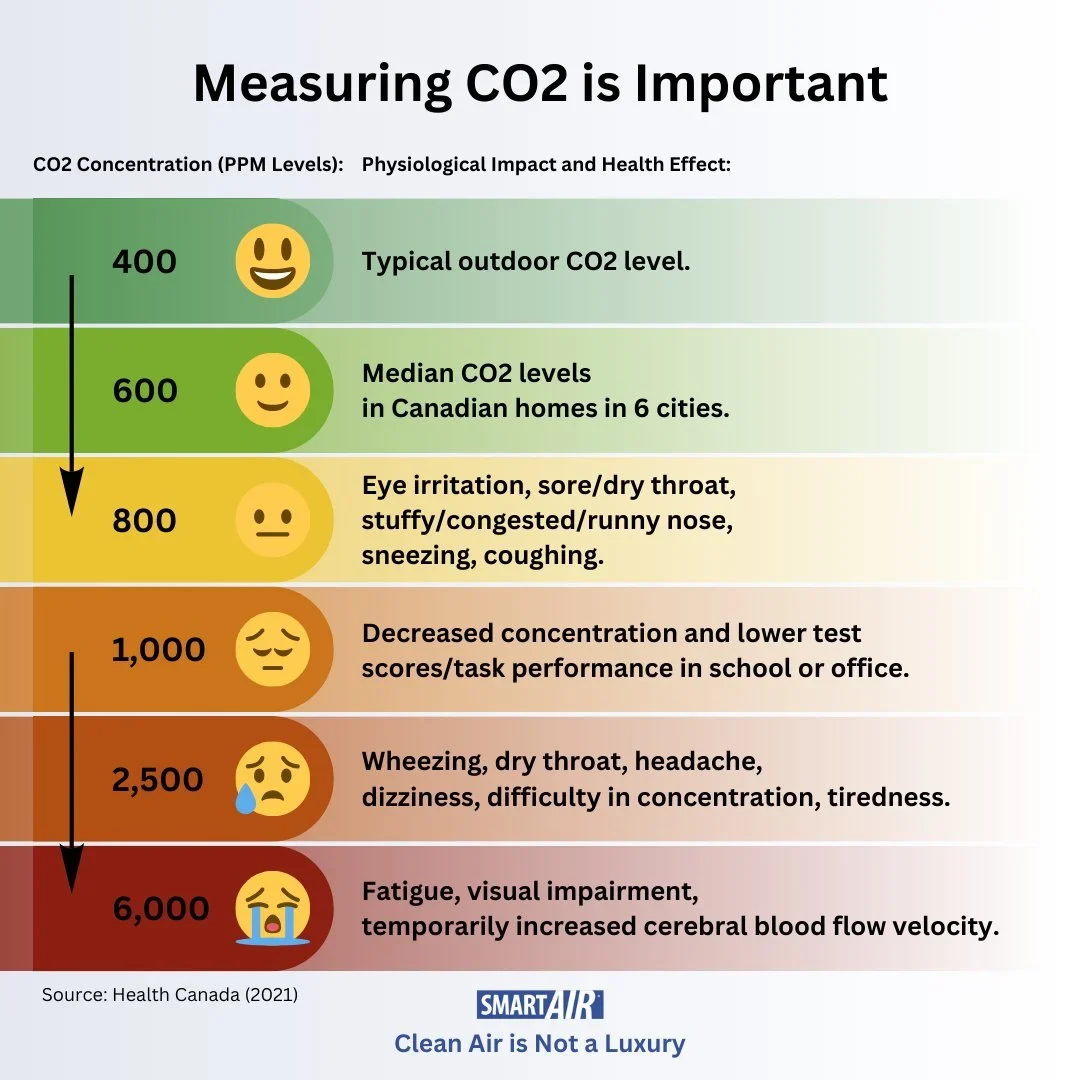
Carbon dioxide is a naturally occurring gas we exhale when we breathe out. CO₂ levels are therefore used to assess indoor ventilation. The Department for Education (DfE) provided all schools with a CO₂ monitor and advised that they should be used consistently and regularly to identify when ventilation needs improvement. However, there is no requirement to record or share the data. Implementing the monitors has been problematic, training has been sparse, and compliance has been poor. In reality, many CO₂ monitors are unused.
Carbon dioxide (CO₂) monitors indicate how much of the air we breathe has already been exhaled by others. CO₂ concentration is measured in parts per million (ppm). Outdoor air typically contains about 415 ppm of CO₂. Indoors, poor ventilation can cause CO₂ levels to rise; concentrations above 1,000 ppm suggest that more than 1.5% of the air has been rebreathed. If an infected person is present, this also means a higher concentration of airborne virus and an increased risk of transmission.
Guidelines recommend that CO₂ levels in classrooms remain below 800 ppm. While this can sometimes be achieved through natural ventilation, it is often challenging because classrooms are up to four times more densely occupied than typical office spaces.
"CO2 levels will be constantly changing so you should
check the monitor regularly"
Department for Education
Every classroom should have a CO₂ monitor on display to track ventilation levels in real time. Natural ventilation through open windows can vary greatly with weather conditions and tends to be more effective when the outdoor air is colder. In winter, for example, a classroom may be well ventilated without fully opening all windows, or simply by refreshing the air for a few minutes every half hour. CO₂ monitors can help strike a balance between maintaining comfort and managing heating costs while ensuring good air quality.
For instructions on how to use a CO2 monitor, download this comprehensive poster from the National Education Union. For alternative sources of information, visit the Health and Safety Executive or the Department for Education.
CO2 monitors should be placed:
- At head height when seated
- Away from ventilation outlets, such as grilles or windows
- At least 0.5 m away from occupants (closer than this could give inaccurate readings).

*These graphs show examples of CO₂ levels measured in UK secondary school classrooms. The graph on the left illustrates that CO₂ concentrations are significantly higher inside the school than outdoors. The graph on the right shows that as pupils arrive in the morning, CO₂ levels quickly rise above the recommended 800 ppm. They fluctuate throughout the day as pupils move between classrooms, remaining above 1,500 ppm for extended periods. Levels drop sharply at 3:30 p.m., when the monitor was removed from the classroom after pupils went home.
Monitoring Air Quality
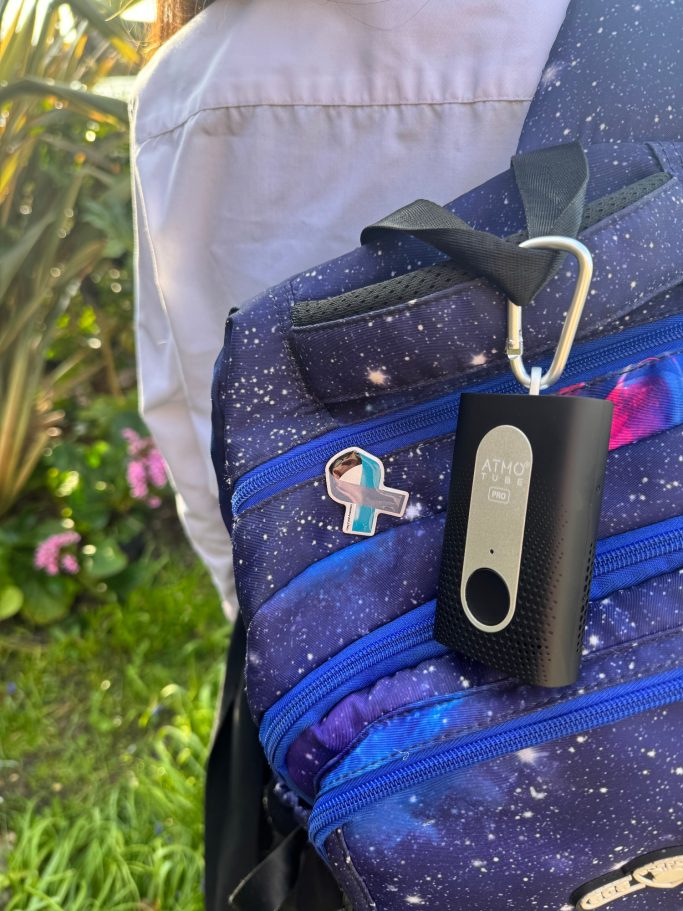
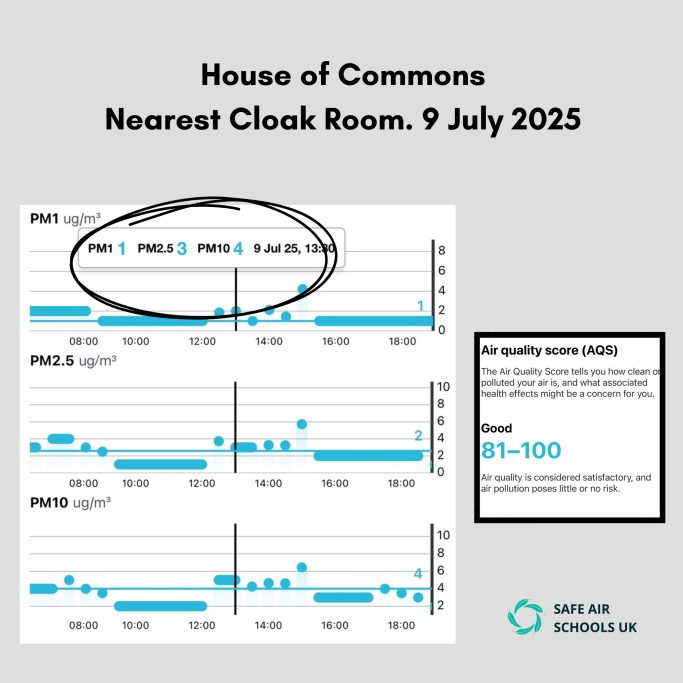
There is limited information on the accuracy of some low-cost air quality monitors in detecting indoor pollutants. Models differ in size, intended use (indoor or outdoor), and the specific contaminants they are designed to measure. Many devices provide unreliable or even inaccurate readings, particularly for volatile organic compounds (VOCs), such as chemical vapours and formaldehyde. It is therefore important to research products carefully before purchasing. The guide by HouseFresh is an excellent place to begin.
Ventilation Guidelines
Individual settings are responsible for maintaining adequate ventilation. The Department for Education (DfE) and teaching unions have issued guidance to schools on ventilation and the use of air filters. However, there are currently no requirements for routine air quality monitoring in schools, nor mechanisms to enforce existing guidelines. As a result, many classrooms do not meet recommended ventilation standards.
The British Council for Offices (BCO) has updated its ventilation standards, lowering the recommended CO₂ concentration to 800 ppm. This aligns with REHVA (Federation of European Heating, Ventilation and Air Conditioning Associations) guidance, which recommends maintaining levels between 600–800 ppm to ensure reliable indoor air quality. Similarly, the Scientific Advisory Group for Emergencies (SAGE) advises that CO₂ concentrations should remain below 800 ppm. However, the Department for Education (DfE) has not updated its 2018 guidance for schools to reflect these revised standards. The existing DfE guidance further states that “the maximum concentration should not exceed 2000 ppm for more than 20 consecutive minutes each day when the number of room occupants is equal to or less than the design occupancy.”
The Health and Safety Executive (HSE) advises that CO₂ levels consistently above 1500 ppm in an occupied room indicate poor ventilation, and action should be taken to improve air exchange. As CO₂ concentrations rise beyond 1000 ppm, occupants may experience headaches, dizziness, and other symptoms, highlighting the need to enhance ventilation.
It is crucial to update and enforce guidelines. It is time for health-based rather than minimum indoor air quality standards in our schools
Guidelines must be updated and enforced to improve ventilation in existing school buildings and to ensure that future investments in school infrastructure prioritise indoor air quality. In Ireland, the Health and Safety Authority (HSA) has introduced a Code of Practice for Indoor Air Quality (IAQ), which has been signed into law. This code requires that all classrooms and workplaces maintain CO₂ levels below 1,000 ppm. Where this cannot be achieved through natural ventilation alone, air filtration systems should be installed to remove harmful contaminants. The new Code provides employers with practical guidance on managing IAQ in the workplace. The rest of the UK should adopt similar measures to protect the health and well-being of staff and pupils.
Benefits of Good Ventilation
- Reduced risk of respiratory illnesses and allergic reactions such as asthma by removing large particles and dust and preventing the build-up of mould.
- Reduced risk of spreading and catching diseases such as flu and COVID-19
- Improved mental health and sleep
- Less illness and fewer related absences for staff and students
- Improved productivity and concentration of staff and students
- Reduced asthma symptoms
- Improved cognitive function and test scores
Warning Signs of Bad Ventilation
- The air feels stuffy or the room feels too hot
- The air smells unpleasant and is not dissipating
- The room feels muggy or there is any condensation or damp
- There is any mould growth
- Alerts by CO2 monitors
Filtering Classroom Air
For cases where natural ventilation is inadequate, or there is outdoor pollution (especially particulate matter PM2.5 from traffic), complementary technologies are needed. Filtration is an effective alternate way of removing exhaled aerosol from a room, as well as pollen, PM2.5 from traffic, dust, smoke, and many other types of pollution from indoor and outdoor sources.

"We know [air filters] work, so use them where there are infection risks and ventilation is not sufficient."
Professor Catherine Noakes OBE
Environmental Engineering for Buildings at the University of Leeds
Portable air cleaners (also known as “air purifiers” or "air filters") use a technology called HEPA (high efficiency particulate air) [filter] to filter the air. They are plug-in portable boxes that suck air in at the sides and blow filtered air out, usually from the top. They use very little power, with some models consuming less energy than a light bulb. Portable air filters should be used in addition to natural ventilation because they do not reduce CO2 levels or affect the humidity of a room.
Market Regulation
The portable air cleaner market is badly regulated, open to marketing misinformation and bold claims that can confuse consumers. It is, therefore, difficult to compare machines. Experts state that manufacturers should be clear about a machine's performance; added technology should be proven effective, published and peer-reviewed, while terminology and standards should be clear and consistent globally.
The TAPAS network (Tackling Air Pollution At Schools) recommends introducing an accredited organisation to ensure objective assurance of the safety and efficacy of devices, in realistic environments, considering both biological and chemical pollutants. They are a network comprising stakeholders across academia, education, public policy, civil society and business. They work together to support the development of healthy schools by improving air quality.
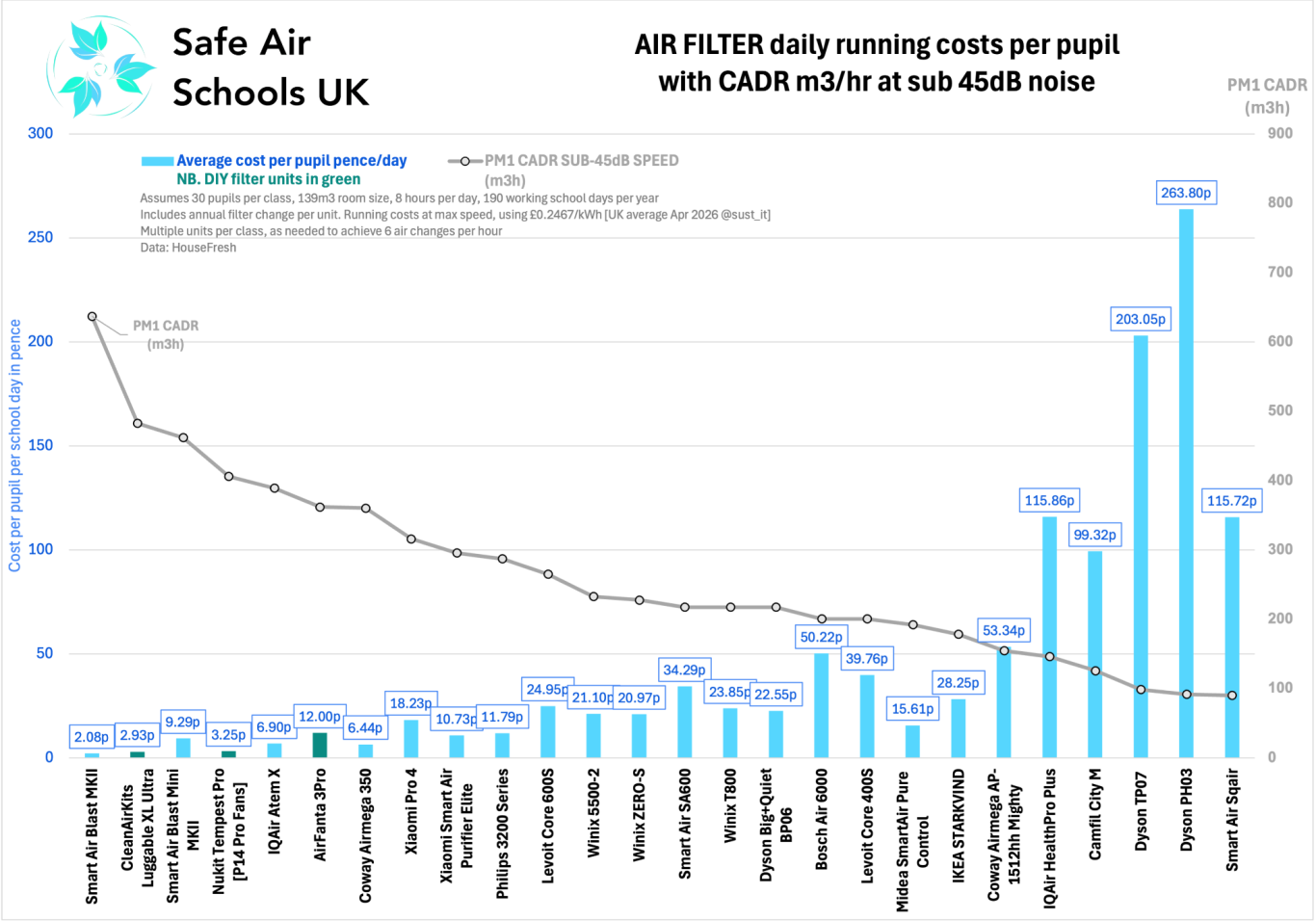
To highlight these issues and initiate conversations, we have demonstrated, in collaboration with HouseFresh, how cost and performance vary across a selection of filters.
Selecting a Portable Air Filter
Things to consider
1.
Classroom Dimensions
An average classroom is 55m2. To find the overall room volume, multiply the room height by width by length.
2.
Requirements
The primary challenges in schools are clearing PM2.5 and biological contaminants, such as viruses.
3.
Guidelines
Air Changes Per Hour. The World Health Organisation recommends SIX Air Changes Per Hour (ACH) for schools. Air Changes Per Hour means the number of times that the air in a room is completely removed and replaced in an hour. With air filtration, the air is cleaned rather than removed, so the term used is equivalent Air Changes Per Hour (eACH).
Air flow. Ventilation is measured in litres per second per person in the space. Many experts, including the World Health Organisation recommend a minimum of 10 litres per second per person.
Noise. It is recommended that noise levels are maintained below 40-45 decibels.
Available Space. UK classes typically comprise 30 students, and space is in short supply. Some units require placement in the centre of a room or raised from the floor. Some spaces will require more than one air filter. Experts state that having several air filters spaced around a room provides more effective filtration than a single filter.
Available Plug Sockets. More than one filter may be required per class, requiring sufficient plug sockets.
Replacement Filters. Filters will need to be replaced and periodically cleaned. The price of each filter, how quickly and practically it is to replace and source them, are all important considerations for schools. Manufacturer's recommendations on maintenance and replacement should be followed. Some machines have a carbon filter as standard or offer this as an option. It removes gaseous contaminants from the air that the HEPA filter cannot. It isn't needed to mitigate against viruses.
4.
Air Cleaner Efficiency
Not all portable air filters are created equal, and that’s where the Clean Air Delivery Rate (CADR) comes in. CADR is an industry-standard measure that provides a reliable way to compare one air purifier with another. It indicates the total volume of clean air a purifier produces each minute, measured in cubic feet per minute (CFM). In simple terms, it shows how powerful and effective the unit is at cleaning the air.
A higher CADR rating means the purifier can clean the air more quickly and efficiently. In contrast, a lower CADR rating may struggle to remove pollutants effectively, which could leave students and staff exposed to harmful airborne particles.
When choosing an air purifier for a classroom, ensure the device’s CADR is sufficient to purify the air at least six times per hour. Depending on the room size and layout, more than one unit may be needed to meet recommended safety and efficiency standards.
5.
Cost, Claims and Hidden Extras
The portable air filter market is poorly regulated, which means some products make bold claims or use misleading marketing. It’s important to look beyond advertising and focus on performance data.
One useful comparison is Clean Air Delivery Rate (CADR) per pound (£), which helps assess how much clean air you get for your money. However, a high CADR value doesn’t always mean better performance in real-world use. If a unit is noisy at higher fan speeds, staff may turn it off, reducing its overall effectiveness.
Some air purifiers include built-in technology or extra features that can significantly raise the price without offering any benefits. In most cases, simple air filters are best. Be cautious with devices that add substances to the air or alter its chemical composition, as these can potentially affect indoor air quality.
Filter replacement frequency, and ongoing maintenance costs are also important factors to consider when selecting the right purifier.
6.
Type of Filter
There are several types of air filters to choose from. MERV 13 HEPA filters are one of the best options for classrooms.
HEPA stands for High-Efficiency Particulate Air. These filters can remove at least 99.97% of airborne allergens and pollutants, helping to keep indoor air clean and healthy.
MERV, or Minimum Efficiency Reporting Value, is a rating that measures how well a filter captures particles between 0.3 and 10 microns (µm). A higher MERV rating means the filter is more effective at trapping smaller and more specific particles.
Another common type is the activated carbon filter, which uses activated charcoal to remove odours, chemicals, and smoke from the air. While these filters don’t capture allergens or bacteria and need to be replaced regularly, they can be a useful addition for improving air freshness.
Other options include ionic, ultraviolet (UV), and ozone filters.
Experts warn: Avoid additive air cleaning methods or similar products such as ionisation until there is a standardised way to ensure their safety and effectiveness.
For sources and references, refer to How to Chose A Commercial Air Filter
